Glory to God in the Lowest (Luke 2:19)
Big Idea: Christmas shows that God came quietly and humbly to save anyone who knows that they need him.
Christmas is a time of surprises.
A woman was busy preparing her Christmas cookies when she heard a knock at the door. Opening it, she found a man dressed in shabby clothes, clearly looking for some holiday odd jobs. "Is there anything I can do for you?" he asked. She thought for a moment and replied, "Can you paint?" "Yes," he said confidently, "I'm a pretty good painter."
"Great," she said. "There are two gallons of green paint and a brush over there. The porch out back needs painting. Please do a good job, and I'll pay you whatever it's worth." "No problem," he said. "I'll have it done in no time."
She returned to her baking and didn’t give it another thought until she heard another knock at the door. When she opened it, she saw the man, now splattered with paint. "Did you finish the job?" she asked. "Yes," he replied. "Did you do a good job?" she pressed. "Yes, ma'am," he said, "but there's one thing I should mention. That’s not a Porsche back there. It’s a Mercedes."
Christmas is a season of surprises, and that’s a gift in itself. Life's best moments aren't measured by how many breaths we take but by the breathtaking experiences that leave us in awe. Christmas brings moments of joy: a song in the air, a baby in a feeding trough, and a world transformed where the impossible becomes possible.
Have you ever realized that in the whole narrative of Christmas in Luke 2, Mary couldn't speak? In all of Luke 2, there's not one word of Mary recorded. It's as if what happened to her was too deep to be expressed in syllables. "But Mary treasured up all these things, pondering them in her heart" (Luke 2:19). She was caught up in her mind, and her thoughts were centered upon the miracle that God was performing right in front of her.
This sort of experience is uncommon today. In our busyness, we are too busy to stop and think and ponder. We spend much more time doing than being. Our faith has become a very exterior thing with much more commotion than devotion.
I remember the first time I bought a hollow chocolate egg. I could not believe the size of the egg for the price I was paying. But there was one problem: I didn't understand what "hollow" meant. So I bit into the egg and quickly found out that the egg was impressive from the outside, but it had no core or inner substance. Many of us are like this: we're impressive Christians on the outside, but there's no inward substance. We're not like Mary, who silently pondered these things in her heart.
But friends, eternity is silent. We are noisy, and the speed and noise of our life signal weakness. Especially around Christmas, but for some of us all year long, the pace of our lives makes us deaf to God. But Christmas is a time when we can sit back and follow Mary's example. She held her son to her breast and leaned against the warm, damp earth, and pondered everything that had happened in her heart.
What Mary Pondered
What do you think Mary pondered?
I think she pondered, first of all, the quietness of Jesus' arrival.
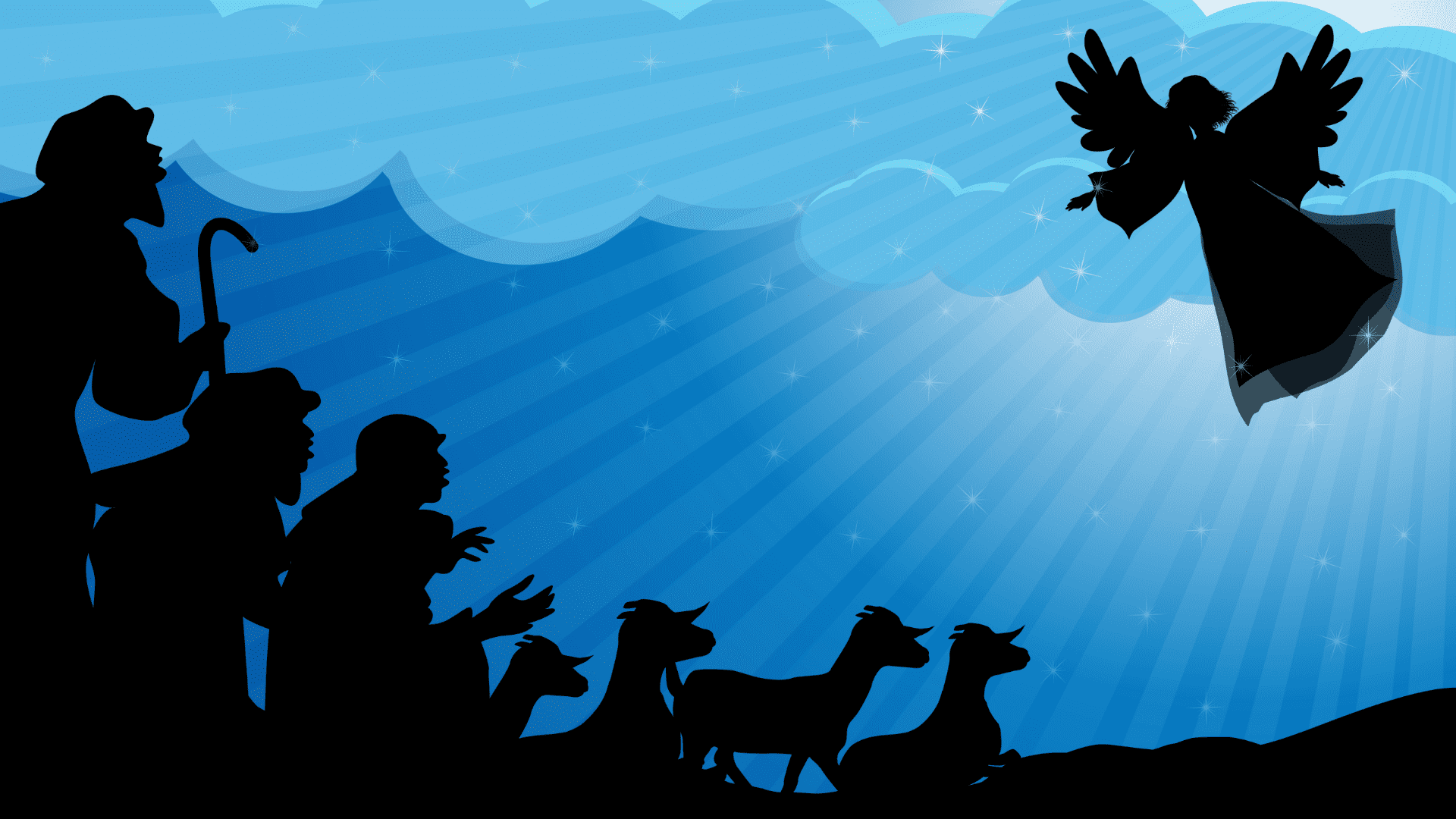
He did not come with noise and clamor. There was no Bethlehem spectacular. While the angels sang, there were only some shepherd boys to witness it. It's interesting that nowhere in Scripture does God knock anyone's door down. Instead, it says:
Behold, I stand at the door and knock. If anyone hears my voice and opens the door, I will come in to him and eat with him, and he with me. (Revelation 3:20)
There's a painting of that by Holman Hunt in the British National Gallery in London. Jesus stands there, gently rapping at a door, the door unopened. A little boy was standing in front of that painting with his father. "Daddy," he said, "why don't they answer the door?" The father replied, "I don't know why." After a moment's pause, the little boy said, "Maybe they're making too much noise to hear him knocking." That little boy was probably right.
The infinite power of God often moves in silence. He works in quietness. God is often found where the noise fades away. God often speaks not through grand displays, but in the quiet, Spirit-filled moments.
It was the same with Mary. That’s what Christmas should be—a time stripped of distractions, when the world holds its breath to hear the soft cry of a baby. God comes quietly, then and now.
I think Mary pondered the quietness of God's arrival.
I think she also pondered the lowliness of his arrival.
Jesus was born in what was probably a cave, one of many in that area. While we often associate Christmas with the fresh scent of hay, a more accurate smell might be the layers of animal dung on the floor. A short distance away, within sight, was Herod's great palace built on top of a mountain, a huge structure with a pool twice the Olympic size. But Christ was not born there; he was born among the smell of cattle dung in a dark and damp cave.
A European monarch would occasionally dress as a peasant to mingle with his people. His advisors worried about this, but the king said, "I cannot rule my people unless I know how they live."
God came as a baby in a cave. I read about a Hindu who couldn’t accept Christianity because he found it hard to believe in a God who would humble himself. Then one day he came across an anthill. He tried to get close enough to study it, but every time he bent low, his shadow caused all the ants to scurry away. He realized that the only way to truly understand the ant colony was to become an ant himself. And that was the moment in which his conversion began.
What’s truly astonishing is that Jesus saw exactly what life in this broken world would entail. He knew the cost: becoming a helpless baby, living as a man, enduring the cross, and bearing the shame. Yet he willingly entered our midst, bringing all our conflicts and chaos into the heart of heaven’s peace.
I think Mary pondered the quietness and the lowliness of Jesus' arrival.
I also think that Mary pondered the lowliness of his audience.
The first ones to learn of Jesus' birth were the shepherds. If Jesus had been born in Nazareth, musicians would have serenaded his birth, following the customs of the time. But it was not so there in Bethlehem. Only shepherds.
The Pharisees of that time said there were six professions that were unworthy. One of those was being a shepherd. A shepherd was not permitted to give testimony in a court of law. A shepherd was not permitted to enter a synagogue, because his activities were considered ritually unclean. People did not have dealings with shepherds. Shepherds in that time were usually very young, just as David in the Old Testament was only a boy. The shepherds, of course, could not have grasped what happened. You can't capture Niagara in a teacup, or the ocean in a single straw. But they were the first to know of it.
This reminds us that the core of the gospel is that knowing God is not just an intellectual activity. It's not something that God only gives to the powerful or the intelligent. It's to the shepherds. It's to the ungood.
Some children wrote to Santa. One child wrote, "Dear Santa, you did not bring me anything good last year. You did not bring me anything good the year before that. This is your last chance. Signed, Alfred." Another one said: "Dear Santa, there are three little boys who live at our house. There is Jeffrey; he is 2. There is David; he is 4. And there is Norman; he is 7. Jeffrey is good some of the time. David is good some of the time. But Norman is good all of the time. I am Norman."
But we're not Normans. We're shepherds. We need to learn humility. Reading about the vastness of space reminds us how small our lives are, making us feel humble in the face of eternity. I have no political significance. I have no distinguished vocational accomplishments. I look at my inner life, and I see weakness and ugliness and sin. But Christmas speaks to all of that.
Christmas shows that God chooses the foolish to surprise the wise, the weak to humble the strong, and the lowly to challenge the powerful. It’s the profound announcement that we matter enough to God for him to step into our world and draw near to us.
We send space probes to the farthest reaches of our solar system. As they journey beyond the moon, they reveal a universe that is dark, barren, and cold—a place where death seems to reign. These advanced machines transmit signals of hostile atmospheres, volcanic eruptions, and desolate landscapes filled with fog, ash, and ice.
And then we turn our gaze back to Earth. Here, we find friends, fields, forests, and fruits. We see seas and mountains, musicians composing songs, painters creating beauty, and philosophers exploring thoughts never before conceived. We have dreamers who envision the impossible, visionaries who create lofty ideas, and engineers who establish solid foundations for them. In that moment, we realize: we are the visited planet.
Christmas is a time of surprises, but none greater than this: God himself entered our world to save us. He came not with fanfare, but in quietness and humility. He came not to the powerful, but to the lowly. He came not to condemn, but to rescue.
The story of Christmas is the story of God stepping into our brokenness. Jesus willingly became a helpless baby, lived among us, and endured the cross to reconcile us with God. He came for the shepherds—the outcasts, the unworthy, the ones who knew they needed grace. And he came for us, too.
The good news of Christmas is that God didn’t wait for us to clean ourselves up or prove our worth. He came to us as we are, offering forgiveness, hope, and new life through Jesus.
This Christmas, don’t miss the invitation. Jesus stands at the door and knocks, offering to come in and transform your life. Open the door. Trust him. Ponder, like Mary, the wonder of God’s love and the gift of salvation. Glory to God in the lowest, who came to lift us to the highest. That’s the heart of Christmas.
Adapted from a sermon preached by Bruce W. Thielemann