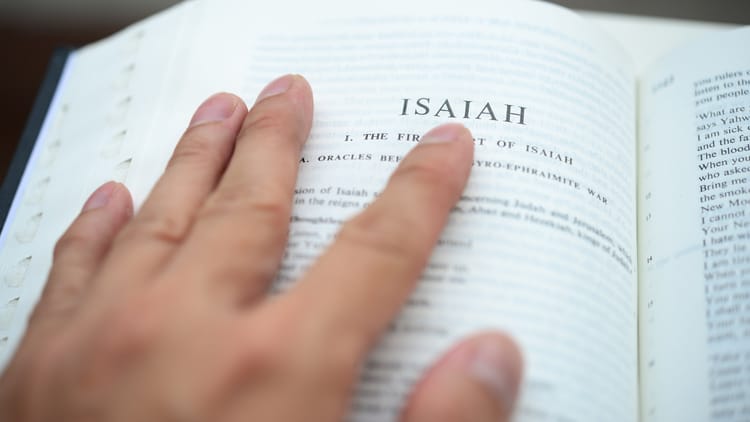
Where to Turn in Crisis (Isaiah 26:1-6)

Big Idea: In crisis, trust in God for the security, peace, and protection that you need.
I’ve been spending a lot of time in Isaiah lately. I really hope that one day we can go through this book together.
Here’s what the first part of Isaiah (chapters 1 to 39) is all about.
- Situation: Isaiah was written in a time of severe crisis for Judah. For some time, Judah was in pretty good shape, but now that had all changed. They were in big trouble. The world had shifted. The Assyrian Empire was aggressively expanding westward, systematically conquering nations and deporting populations. For Judah, this created an existential threat. It looked like they were about to get steamrolled.
- The theological perspective: What was happening in the world wasn’t just random. God is active in history. Isaiah identifies the crisis as God's direct judgment on Judah's covenant unfaithfulness, with the Assyrian threat serving as God's instrument of discipline. In other words, their problem wasn’t just the Assyrians; it was God’s judgment against their sins.
- The question: Where would God’s people turn for hope in a time of crisis? Would they trust God to save them or come up with their own strategies of self-salvation?
You can see how relevant this is for today.
- Situation: We often face crises. Our lives may seem fine, but everything can change suddenly, leading us into an overwhelming existential crisis.
- The theological perspective: Let me be clear. The people in Isaiah’s day knew the reason for the crisis they were facing because Isaiah told them. We just don’t know. We don’t have a tidy explanation for what God is up to. But there is one insight we can hold on to as we learn from Isaiah: God is up to something. God is always at work, even in difficult situations, and nothing is beyond his control.
- The question: Where will we turn in this crisis? Will we trust God for help, or will we come up with our own strategies to handle this situation?
In other words: We’re going to face crises. We know that God is at work even in these crises. How will we respond? When our world implodes, where will we turn for the help we need?
Judah failed the test. They trusted in political alliances and shored up their defenses, fortifying the walls and the water supply. But they didn’t succeed. We will never succeed when we take matters into our own hands when we face a crisis. Self-reliance is never the answer. Mark my words: if we turn to our own strategies or to people for the help we need, it will never work. We will never get the help that we need.
But in Isaiah 26, Isaiah tells us where we can turn. Isaiah 26 highlights the end of history, when all human power ceases and only the city of God remains. The passage we just read is all about anticipation. Isaiah believed that despite our current pain and confusion, history is guiding us to a time when evil will end, God’s reign will be supreme, and his people will be eternally safe.
And Isaiah has four messages for us in the first six verses of Isaiah 26. Here’s the first message:
There’s only one place we can find the security we need (26:1).
In that day this song will be sung in the land of Judah: “We have a strong city; he sets up salvation as walls and bulwarks.”
Remember: They faced a crisis. Jerusalem was not secure. They responded by trying to make it secure through building projects. Chapter 22 describes what they tried to do:
In that day you looked to the weapons of the House of the Forest, and you saw that the breaches of the city of David were many. You collected the waters of the lower pool, and you counted the houses of Jerusalem, and you broke down the houses to fortify the wall. You made a reservoir between the two walls for the water of the old pool. But you did not look to him who did it, or see him who planned it long ago. (Isaiah 22:8-11)
They knew they were in trouble, so what did they do? Three things: they got their weapons out. They repaired the wall. And they tore down houses between the two walls of the city and filled them with water like a moat for extra defense.
But none of that worked. None of that was enough. They could never make their city strong enough for what is coming.
Listen: When we face a crisis, we try our own building projects. We try to build defenses. We come up with our own strategies to save ourselves. But they never work. They are never enough to provide a real defense for the crises we will go through.
We may also be tempted to run elsewhere to escape the trial. The people in Judah could have said, “We’re out of here.” But that’s just another human strategy of self-salvation that will fail. Whenever we try to run from the problem, it’s just another form of self-trust. Isaiah makes it clear they can run, but the only place they can run that will help is to him. Don’t run away from crisis; that never works. Run to the Lord in crisis.
So where do we go for the security we need? We look to eternity, to the strong city that God is building, to the walls and bulwarks that God is building. They will be enough. They will provide the security we need. Nothing will be able to touch us there.
Right now we live in the city of man. It will always be disappointing. We will always feel insecure here. We will never be able to build the defenses we need.
But God will build them. One day Zechariah 2:5 will be true for us: “And I will be to her a wall of fire all around, declares the LORD, and I will be the glory in her midst.”
We need to hear this in the middle of every crisis we face. Quit building your own defenses. Quit thinking you can come up with your own solutions for the security you crave. You can’t build that city, but God is building it. He will give his people peace and security after their long suffering and many failures. It’s the only place where we will get the security we need.
Friends, please don’t waste this crisis. Please don’t come up with your own strategies and solutions. There's only one place to find the security you need, and that's in God. His salvation is like a mighty city where we can live permanently and safely, now and forever. Every other strategy will crumble.
That's the first lesson. There's only one place where we can find the security we need. Here's the second lesson:
The way in is trust (26:2).
How do you get in this city? There are watchmen. Not everyone can get in. But verse 2 addresses the watchmen and tells them who is admitted to this secure place:
Open the gates,
that the righteous nation that keeps faith may enter in.
There is an open invitation to enter this city. The gates are not closed. The city is secure, but there is a way to enter. It reminds me of Revelation 21, which says that the gates of the heavenly city “will never be shut by day—and there will be no night there” (Revelation 21:25).
This is amazing news. I’ve been in situations where what I need is locked up and inaccessible to me. It’s frustrating, and it’s not even as important as this. The keys are locked in the car. You’re locked out of your house. It’s intensely frustrating when this happens.
This is not the case with God. What you want is right there if you want it. The gates are open wide.
But not everyone gets in. Who gets in? The one qualification for entry is trust in the Lord. The ground of admission is being right with God. And the evidence of being right with God is that it has changed your life. If you have experienced grace, that grace will show up in how you live. The only way we’ll be able to get in is not our faithfulness to the Lord but his faithfulness to us
Here’s what Isaiah is saying: Don’t build your own defenses. Instead, flee to the only place that is safe. And you can get in. The doors are wide open, but only for those who are right with God by faith as evidenced by a changed life.
Turn to God to find the security you need. The way in is trust. Here’s the third lesson Isaiah teaches us:
If we trust him, we’ll experience his peace and protection (26:3-4).
Verses 3 and 4 describe one possible outcome of your life if you enter this city:
You keep him in perfect peace
whose mind is stayed on you,
because he trusts in you.
Trust in the LORD forever,
for the LORD GOD is an everlasting rock.
Here’s what life looks like for those who trust God: perfect, unbroken peace. In the Hebrew, it’s “peace peace.” It’s a way of emphasizing the quality of peace that God’s people will enjoy. This peace is the real thing. Matthew Henry says:
Thou wilt keep him in peace; in perfect peace, inward peace, outward peace, peace with God, peace of conscience, peace at all times, in all events. Trust in the Lord for that peace, that portion, which will be for ever. Whatever we trust to the world for, it will last only for a moment; but those who trust in God shall not only find in him, but shall receive from him, strength that will carry them to that blessedness which is for ever. Let us then acknowledge him in all our ways, and rely on him in all trials.
We will experience peace because God is an everlasting rock, as stated in verse 4. Think about this metaphor. What does it mean that God is our rock? A rock has some characteristics we need:
- Permanence: Unlike shifting sand or unstable ground, God's nature never changes. His love, faithfulness, and promises remain constant regardless of our circumstances or feelings. When life feels chaotic, he remains our fixed point.
- Protection: In ancient times, people fled to rocky cliffs and caves for safety from enemies or storms. Similarly, God provides shelter from life's spiritual and emotional storms. He's our hiding place when we're overwhelmed.
- Strength: Just as a house built on rock can withstand fierce weather, a life built on God's truth and character can endure trials. When we feel weak or unstable, we can lean on his strength. The rock doesn't move when we press against it; it supports our full weight without shifting.
This is why we can experience perfect peace when we turn to God. He is our rock. Everything else will let us down; he offers the lasting protection and strength that we need.
We can apply this by being patient and enduring uncertainty during difficult times, even when we don't see the whole picture. Judah had to endure and wait upon the Lord for a very long time. But when you have peace and protection, when you have a solid rock, you can endure trials. What is God calling us to? Patient endurance. God is calling us to trust in him and to find peace and strength in him, and then faithfully and patiently endure in this season.
There’s one more lesson Isaiah has for us:
If we don’t trust him, we’ll be laid low and trampled (23:5-6).
But if you don’t turn to God, there’s another outcome referenced in verses 5 and 6:
For he has humbled
the inhabitants of the height,
the lofty city.
He lays it low, lays it low to the ground,
casts it to the dust.
The foot tramples it,
the feet of the poor,
the steps of the needy.
Isaiah is pointing out that the world looks really good right now. It looks like they have all the solutions. But all the powerful in whom we’re tempted to put our trust will one day be humbled. Everyone who is proud will be humbled, but the poor and the needy who trust in Christ will be saved.
Isaiah spoke to his own people who were in crisis, and he’s also speaking to us. They were hopeless and didn’t know where to turn. They could think of a hundred different ways to save themselves. They could think of a hundred places to put their trust other than God.
But Isaiah says: there’s only one place to turn in the middle of crisis. There’s only one place you can find the security you need. Worldly solutions will cost you everything and deliver nothing. The safety and security you need are offered to anyone. The gates are open. All it takes is trust in him.
And once you turn to God for hope in the middle of crisis, here’s what you will find: surpassing peace and a rock that can’t be moved.
Right now we’re going through a crisis. It is human nature to attempt to fix this through our own strategies or to run away. Isaiah’s shown us that neither of these will work.
There’s only one place to turn for help, and that’s to the Lord. In crisis, trust in God for the security, peace, and protection that you need.
This is a time to do two things.
First, place all your hope and trust in the Lord right now. Don’t turn anywhere else for help. Patiently endure. And you can know, even when the world is falling apart around you, that God is at work even if we don’t understand it, that you are safe, and that it is well with your soul even in the worst of circumstances.
Second, don’t do that alone. Don’t run away. I want to encourage you to lean in on each other instead of running away. Let's weep and grieve together and seek the Lord for strength and peace.
So keep your thoughts focused on him. Don’t turn anywhere else for help. And you can know, even when the world is falling apart around you, that you are safe and that it is well with your soul even in the worst of circumstances.